
Some bits of business…
- November 5, 2026 — City Council Committee of the Whole, 5:00–5:50 p.m.
- Presentation on One-Time Tax Revenues
- November 5, 2026 — City Council Study Session, 6:00–10:00 p.m.
- Joint meeting with Planning Commission — Downtown Planning Project — EcoNorthwest
- Executive Session: Potential Litigation under RCW 42.30.110(1)(i)
- November 12, 2026 — City Council Regular Meeting, 6:00–10:00 p.m.
- Proclamation: Small Business Saturday Proclamation
- City Managers Report: Presentation for Small Business Development Center
- B&O Tax Ordinance — 2nd Reading
- City Custodial Services Contract Addendum
- 2027 Property Tax Levy — 2nd Reading
- 2026 Budget Amendments — 2nd Reading
- 2027/2028 Biennial Budget — 2nd Reading
- Canopy Preservation Program Update Follow-Up
- Gambling Tax Increase Ordinance — 1st Reading
- Vacant Commercial Property Registration Program
- Beach Park Buildings Demolition
- Potential Franchise Agreement Extensions
- December 3, 2026 — City Council Committee of the Whole, 5:00–5:50 p.m.
- Police Chaplaincy, a New Model of Service
- MFTE Follow Up
- December 3, 2026 — City Council Study Session, 6:00–10:00 p.m.
- One-Time Revenues — 1st Reading
- Downtown Planning Project — EcoNorthwest
- Executive Session: Performance of a Public Employee RCW 42.30.110(1)(g)
- December 10, 2026 — City Council Regular Meeting, 6:00–10:00 p.m.
- City Managers Report: 2026 3rd Quarter Financial Report
- Gambling Tax Increase Ordinance — 2nd Reading
- One-Time Tax Revenues — 2nd Reading
- Potential Franchise Agreement Extensions
- Executive Session: Performance of a Public Employee RCW 42.30.110(1)(g)
Future Agendas is the closest thing the City currently has to a calendar of upcoming City Council topics. It’s not always accurate. But until we develop a genuine calendar, this can be useful if there is a particular issue you don’t want to miss.
About the cover
At every election people say “this one matters!” As a nation? 100%. For your ballot: eh… maybe not so much? Don’t get me wrong, I encourage you to vote. It matters. But candidly? Most of the key races in WA has been in about the same place for a long time.
People everywhere may think the rest of the world is going to hell and a handbasket. But things here? Not too bad.
There has always been a certain amount of Lake Woebegone in Des Moines. It’s easy to blame ‘the world’ for chronic budget issues, to say that things are tough all over. But we’re doing our part. And at least we’re not (fill in the blank)!
Put another way: our votes will not swing Texas or Maine or the other races that will make ‘the change’ so many people say they want.
What I’m trying to say is that voting is simply not enough. All it seems to be doing over the past few decades is say “we don’t like (fill in the blank)” What it’s not doing is providing a clear sense of direction.
Politics will always be sort of a popularity contest. Most people do not do ‘deep dives’. They get some cues as to who they feel they can trust and let them take the wheel (as the kids say.)
I know it sounds cliche but at some point, people have to be more willing to change their minds. Otherwise, it’s just a race to the bottom: your team taking over, then the next team trying to switch things back. A pendulum clock that eventually slows down and then stops.
My concern is that, at this local level, fewer and fewer of you are actively participating. Here. At the school district. Basically anywhere– except for the outrage-du jour at the national level. My guess is that, if we had to submit to an exam, most of us would score lower on a “how the City government works” pop quiz than when I ran for office in 2019. And I’m not certain how to feel about that.
However, I am pretty sure the nation will swing in a slightly different direction on Tuesday. But my concern is that we’re missing a broader lesson. People are not paying enough attention. And I mean that on all sides.
Highline Schools Bonds
One of those votes, which does not get enough attention, is for construction bonds for local schools. It’s really complicated. But this is a good explainer.
https://www.thehighlinejournal.com/highlines-595-4-million-bond-four-questions-for-voters/
I thought you understood me!
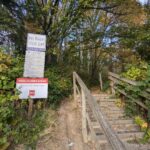
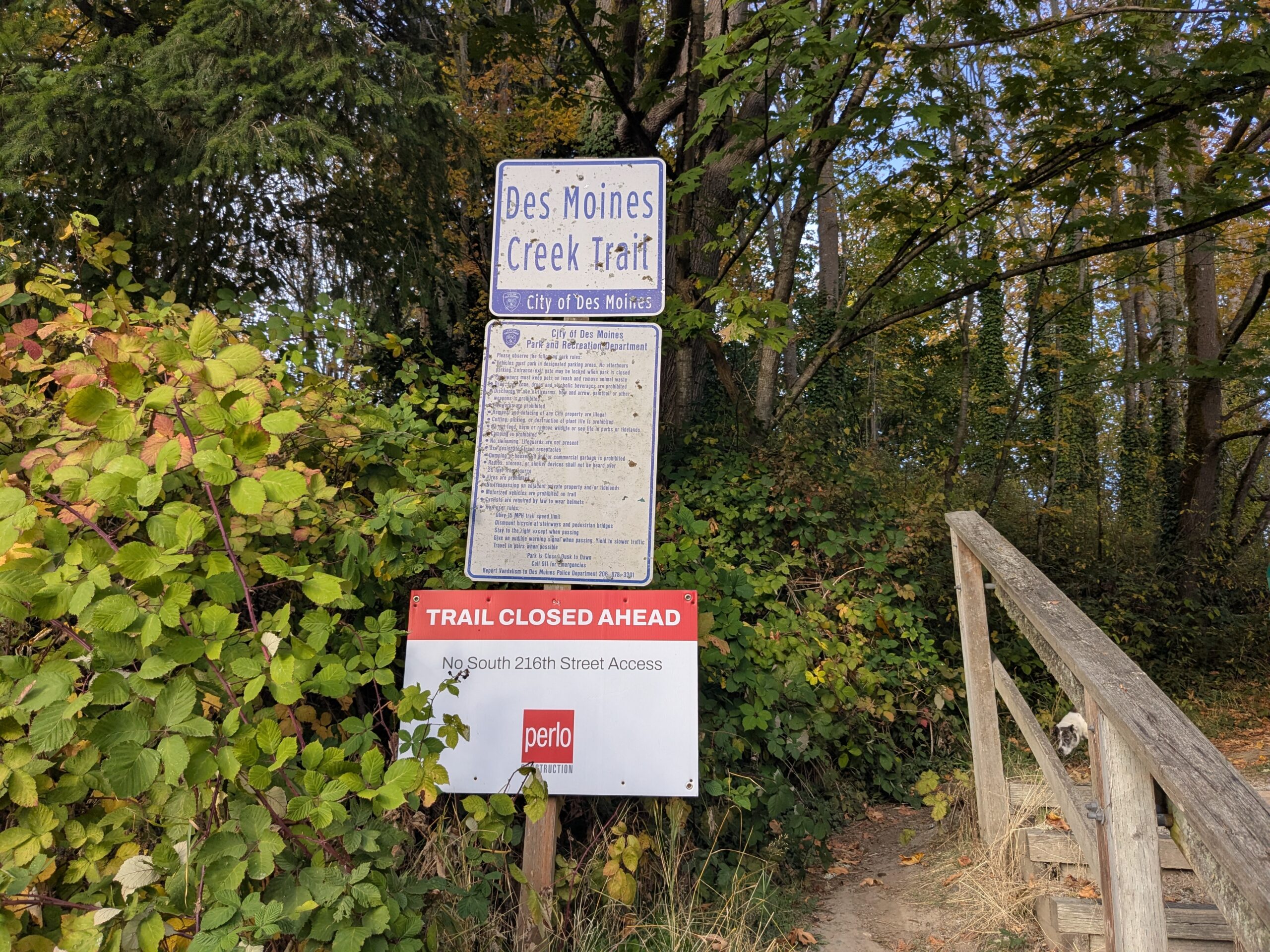 I got a bunch messages about trees and Shield AI. And people really misunderstood. YOU ENTER FROM THE DEAD END AT 14th AVE and whatever. I’ve logged so many miles here I don’t remember the streets. 😀 I assume everyone knows where this is.The point isn’t their 10′ wide asphalt path. It’s the forest behind the ginormous building, ie on the north side of the building. That’s the tree opportunity. That’s the true forested area that could be extended into the DMCT. That’s where the tree replacement opportunities are from all the removed land.
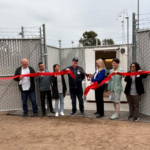
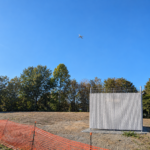
Des Moines Creek Trail Gallery
City Manager Stuff
City Manager Reports! October 30, 2026
The highlight, for moi was the announcement that Blue Origin is taking over the vacant Bartell’s Warehouse. A couple of notes on that:
- From the sound of the news coverage it will provide mainly skilled jobs, the kind SPEEA used to provide for Boeing back in the day.
- That will likely not mean ‘traffic’ — due to the handy-dandy SR-509 exit just down the road.
- It will likely not mean ‘tens of thousands of new visits to our downtown!’ –due to the handy-dandy SR-509 exit just down the road.
- From a budget perspective,
- It is not Port of Seattle property, which means it was always subject to property tax
- But it will be subject to our new Square Footage/Business Tax, which means that regardless, it will create new revenue for our City.
This is a huge deal. Until the 1976 the area was residential and had iconic businesses like Furney’s Nursery. The FAA/Port engaged in a massive buyout program after building the second runway. This left much of the area undeveloped for 40 years–so much so that people thought large swaths of the area were ‘forest’.
What is happening now–the proper funding of the area–is what was intended for Des Moines going back to 1976. For whatever reasons, the City has never done a great job of explaining this to residents, developing the area, and then generating revenue for what was lost. We left tens of millions of dollars on the table and created tremendous anxiety for nearby residents came to think of it as permanent ‘recreation area’.
Moving forward, my hope is that we continue to maximise the revenue-generating potential and do a much better job of tree/habitat replacement in the surrounding areas.
This Week
 Thursday

The November 5 City Council meetings cover two items:
Committee of the Whole (5:00–5:50): One-time revenue ordinance
Background. Ordinance 1561 (2012, codified at DMMC 3.100) bars using sales and B&O tax from projects valued at $15M or more in the General Fund. The remainder would be set aside for big community projects. This was considered a way to get out of the constant boom/bust cycles we’ve been going through since I’ve lived here. “One time money for one time projects!”
The problem was: we never made enough money to stick to the rule. Almost every year I’d watch the Council have to vote for a (cough) ‘one-time use of sales tax funds’; meaning we never lived it.
At bottom, that is why we borrowed money for the Marina Steps. The pool of money we always hoped to set aside for capital projects has never been there.
At her first meeting, City Manager Caffrey seemed to express the sense that one-time money was perfectly fine for regular expenses. The Council objected, but my guess is that, with time, she has convinced the majority of that perspective. I completely disagree. But without these ‘overrides’ we simply cannot pay for even current spending. All this vote will do is avoid the embarrassment of the annual vote.
We continue to take our long-term savings money (think of it like a college fund) and spend it today, rather than working harder to either a) live within our means and b) find new money. It’s wrong.
Study session (6:00–10:00): Downtown planning and zoning workshop
ECONorthwest present this joint workshop with the Planning CommissionIt’s the third of four sessions. A final Council session will confirm a strategy for 2027 zoning changes.
Essentially we are considering offering taller building heights and greater density in the downtown area. This won’t ’eminent domain’ anyone. And it’s no quick fix. It may encourage developers to rebuild, one piece at a time, as parcels become available. To a certain extent, this is inevitable.
But what I caution people about is how much it will make Des Moines “more like Edmonds!” Edmonds is lovely. Their marina was built by the same team that built ours. But the city is very different. For example:
- Their marina is run by an independent commission. It is sited off to the side of their downtown. It doesn’t need a ‘marina steps’ because it’s not connected to downtown like that.
- They have more residential housing near the downtown, but it’s not all in the downtown. It’s next to the downtown. If we wanted to be more like Edmonds, instead of limiting our rezone to ‘downtown’ we’d expand density next to downtown and on all sides.
- They have central parking. This may or may not be the secret sauce. But what is maddening to me is when the City says “we have plenty of parking!” We do. It’s just spread out. For some reason, having one big lot seems to ‘train’ people to expect to walk half a block.
My question at our first meeting was “How many customers does it take to make a bakery work?” Because that’s what residents talk about all the time: bakeries! The key argument of ECO is that ‘retail follows rooftops’, meaning if we build enough new housing, shops like a gourmet bakery will emerge organically. Maybe. But then… why has B&E Meats been able to thrive for 50 years? Isn’t a bakery as valuable an asset as a meat market?
In the recent op/ed to the Seattle Times, the three mayors said that at least one major business had not sited their headquarters in Des Moines because of airport noise. If so, that should be part of this discussion.
There are a lot more factors that determine why businesses choose Des Moines than what I see in this packet. And we should have them all on the table. One biggee: the one-time construction sales tax I mentioned above. When you’re as cash strapped as Des Moines, the lure of construction fees is so strong that leaders sometimes build just to build. But the people who will decide whether or not to move here in the future do not get a vote.
Feasibility findings (8 building prototypes):
- Profitable now: townhomes and 3-story stacked flats.
- Close, with help (MFTE, fee relief, parking flexibility): 5- and 8-story podium buildings. Cost per square foot stays flat from 5 to 8 stories and rents don’t go up with height, so ECO says it’s unclear whether going taller helps.
- Don’t work: standalone strip retail and medical office, because rents don’t cover construction cost. ECO’s summary is that “commercial follows rooftops.”
What blocks development under current code:
- D-C zone: standalone residential isn’t allowed, and the ground-floor commercial requirement is heavy (60% of the floor, 75% of street frontage, 55 ft deep). Heights run 35–55 ft.
- RM-900 and RM-900A: 35 ft height limit, about 48 units per acre, low FAR, and retail is prohibited. RM-900A also bans townhouses.
- All of downtown’s vacant lots are in the D-C zone.
Options, from small to big:
| Small | Medium | Big | |
|---|---|---|---|
| Height | 65 ft at north and south ends of Marine View Dr | 45 ft throughout downtown, 75 ft at the ends | 75 ft throughout downtown |
| Ground-floor commercial | Drop requirement on parts of 7th Ave | Require only on 223rd and Marine View Dr | Drop requirement throughout D-C |
| RM-900/900A | More density and FAR | New, more flexible multifamily zone | Fold into the D-C zone |
State laws that limit the City’s options:
- SB 5184 (parking): starting July 2028, the City can’t require more than 1 space per 1,000 sq ft of commercial space or 0.5 spaces per multifamily unit, and it can’t require any parking for small units.
- SB 6026 (ground-floor commercial): the City can’t require it near light rail or RapidRide, or in 60% of the remaining commercial and mixed-use areas. Des Moines will have to decide where, if anywhere, to keep the requirement.
Fiscal points:
- Downtown housing’s one-time revenue covers close to 30 years of service costs.
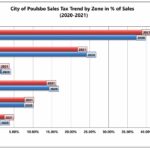
- Property tax grew only about 25% from 2015 to 2025. B&O (+125%), sales tax (+85%) and utility taxes (+60%) carried the growth.
- New construction value is at about 140 on ECO’s index versus about 235 for King County. That matters because new construction is the main way around the 1% levy cap.
Last Week
Tuesday
Big Port Commission Meeting! The Port does not have one budget preview. They have like six. But this one, the last one, is always the biggee. This is the one where they discuss the Tax Levy. (Agenda Packet)
Unlike cities, the Port can adjust the amount it charges all of us in King County up or down, at will, by a simple vote. It isn’t required to, but it is self-aware of this superpower. So, also unlike cities, it makes a big deal out of discussing what specific uses it has in mind. This presentation telegraphs pretty clearly what will happen: both airport expansion and community grants.
Wednesday
5:00 pm StART Meeting at the airport.
6:00pm Citizens Advisory Board (October 28, 2026 Citizen Advisory Board Agenda Packet) The discussion centred on their 2027 work plan. One ongoing scuttlebutt is that the group, originally having twenty three members, has dwindled over time. Not naming names here, but many people often don’t show up and it’s never been representative of the City. Essentially, its fallen back to what we previously had: Human Services Advisory, Arts, Seniors. Each of those subcommittees do great work, but the original intent was to provide a representative voice for all of Des Moines and I cannot say it’s accomplished that particular mission.
FWIW: the ongoing microphone problems were once again in full force, so here is a machine-generated transcript.
Thursday
Big City Council meeting (recap)
October 29, 2026 Recap
Big meeting. This iss why I hate taking so much time off. This really should be two meetings.
October 29, 2026 Agenda Packet
2027-2028 Budget Book – Preliminary 10-18-2026
Highlights
- Consent Agenda
- Marina electric vessel charging: $157,550 contract with Service Electric, including a 15% contingency, for power cabling and chargers at guest moorage.
- Marina tenant restrooms: $97,660 to Green Earthworks for demolition and site prep, plus a $15,000 contingency. The ROMTEC restroom contract rises to $1,063,108 to cover sales tax and bonding.
- Midway Park: accept a King County Youth and Amateur Sports grant.
- 6th and 287th stormwater: $126,100 task assignment to Parametrix.
Public hearings (all first readings, Jeff Friend presenting)
- 2027 property tax levy, two ordinances: the levy amount and the levy increase. It’s a five minute item, basically because it’s pro forma. We’re limited to 1%… and we need every penny of it.
- 2026 budget amendments to the 2025–2026 biennial budget. 15 minutes.
- 2027/2028 biennial budget, advancing to a second reading on November 12. 40 minutes.
New business
- Holiday tree: up to $135,000 for a 44-foot artificial pine package from Christmas Designers. 10 minutes. You may ask why we need this. But the City telegraphed this last year. The unspoken plan was always for the current (real) tree, and harbormaster house, to go away. This does not thrill me.
- Square footage B&O tax update, first reading. 10 minutes. As the original mover of this tax, this also does not thrill me. Raising it after only a year does not seem ‘pro-business’. It also proposes an automatic 3% annual increase. That’s gotta go. No. Automatic. Tax. Increases. Ever.
- Comprehensive Safety Action Plan, adopted by resolution. 20 minutes.
Executive Session
55 minutes on property acquisition and potential litigation. Violating the sanctity of ES can get one sent to hell without an electric fan, but the RCW gave a clue as to the subject matter
- Executive session: 55 minutes on property acquisition and potential litigation. Violating the sanctity of ES can get one sent to hell without an electric fan, but the RCW gave a clue as to the subject matter–which may or may not rhyme with schmairshmort.
- Property acquisition. This is the truly disappointing aspect of local government. People always assume that ‘something’ is happening ‘behind closed doors’ and you are correct. If someone wrote a tell-all book on what happens in ES, it would confirm two things:
- People really like snap decisions. All the ‘deliberative’ crap? The deep analyses? Nahhh. Just like voters, electeds really like going with their gut. This took me a long time to accept because, despite all the talk about ‘corporate backroom deals’, US Corporations are about ten times more transparent than yer average City Council.